About
About Ternhaven
Understand what the college teaches and how its places support learning.
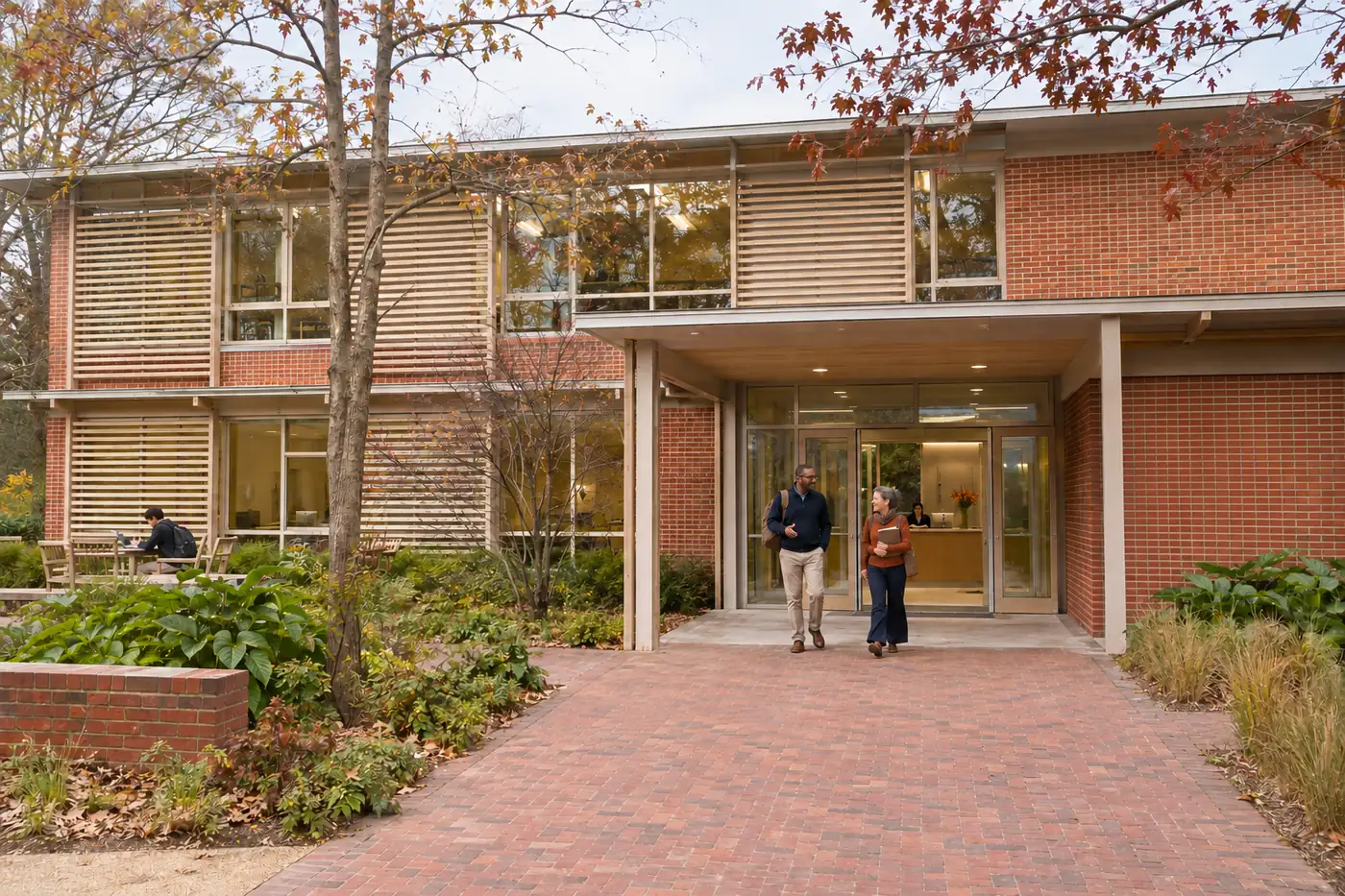
An undergraduate coastal college.
A coast can be studied through a specimen, a map, an archive or a public question. At Ternhaven, students learn to connect those views while keeping the evidence behind each account visible. Eight undergraduate programs share a foundation in careful observation, readable records and discussion across disciplines.
An independent, nonprofit undergraduate college focused on coasts, environments and communities.
Two settings, one learning purpose.
The 46-acre main campus brings teaching, laboratories, library and student services together. Reedwater Field Station provides a separate setting for scheduled nearshore study. Most questions return to the classroom for checking, reading and discussion.
An original relationship diagram, not a navigation map. Box positions, spacing and grouping do not specify distances, paths, entry permission or real coordinates.
What the mission asks.
Develop graduates who can ask a focused question, gather and evaluate appropriate evidence, explain its limits and contribute thoughtfully to the places where they work.
Start with a bounded question.
Define the observation, place, time and comparison before choosing a method. A small well-described inquiry is more useful than an unsupported claim about an entire coastline.
Keep the record with the result.
Retain dates, source descriptions, units, labels and relevant changes. A reader should be able to distinguish an original observation from a later interpretation.
Make alternatives part of learning.
A course can use shore-based observation, existing teaching datasets, accessible laboratory tasks or documentary work to meet a defined learning aim. Discuss individual arrangements before an activity.
Explain what remains uncertain.
A map, sample or interview record offers a partial view. Students practice stating what their evidence supports and which next observation would be needed to go further.