Visitor-use scenario
A Quieter Visitor Route
How does a visitor route change when time, circulation and an alternative reading format are treated as real design constraints?
- Student
- Oscar Duran / Year 3
- Course
- TRM 301 / Impacts and Tradeoffs Inquiry
- Mentor
- Mara Okoye
- Source
- TH-TEACH-TRM-01
Question
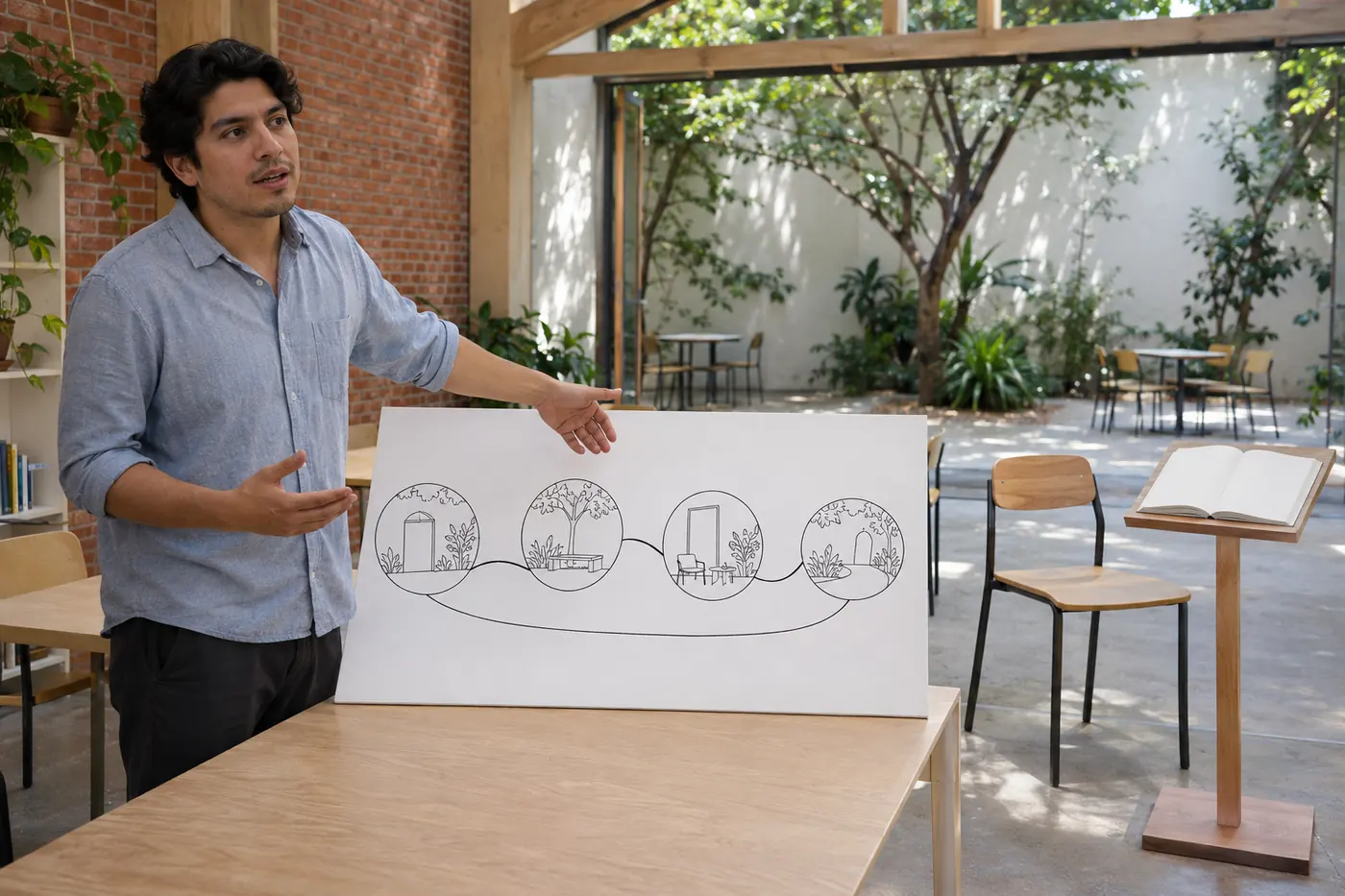
Oscar’s fictional visitor scenario begins at a sheltered reception point and ends at a small interpretation room. His first route followed every available stop and became too long for the assumed visit. The project asked whether a shorter route could preserve the central explanation while reduce repeated movement through the same narrow space.
Method and record
The source pack contains an original schematic, invented stop durations and a stated classroom group size. Oscar separated the assumed walking time from the reading time at each stop, then compared two routes against the same visit window. The diagram is not a real public itinerary, access instruction or operating plan for the field station.
TH-TEACH-TRM-01 / Original simulated teaching sources
Original fictional visitor-use scenario
Assumed classroom group size: 8. This input is not an approved safe capacity.
All-stop route
| Assumed stop | Minutes |
|---|---|
| Arrival | 6 |
| Overview | 8 |
| Place story | 10 |
| Map reading | 12 |
| Reading stop | 10 |
| Assumed transitions combined | 12 |
| Total assumed minutes | 58 |
Short sequence
| Assumed stop | Minutes |
|---|---|
| Arrival | 6 |
| Overview | 8 |
| Combined seated or short-stop interpretation | 16 |
| Assumed transitions combined | 8 |
| Total assumed minutes | 38 |
| Route | Assumed total minutes | Open question |
|---|---|---|
| All-stop route | 58 | Repeated narrow-space movement |
| Short sequence | 38 | Staffing and seated-format availability |
Invented classroom times. Not an approved route, capacity or environmental-impact finding.
Totals are 58 and 38 assumed minutes. A group size is a classroom input, not an official safe capacity. The schematic is not a real route or access instruction; no reduced-impact result is established.
Download the complete original teaching sourceA revision
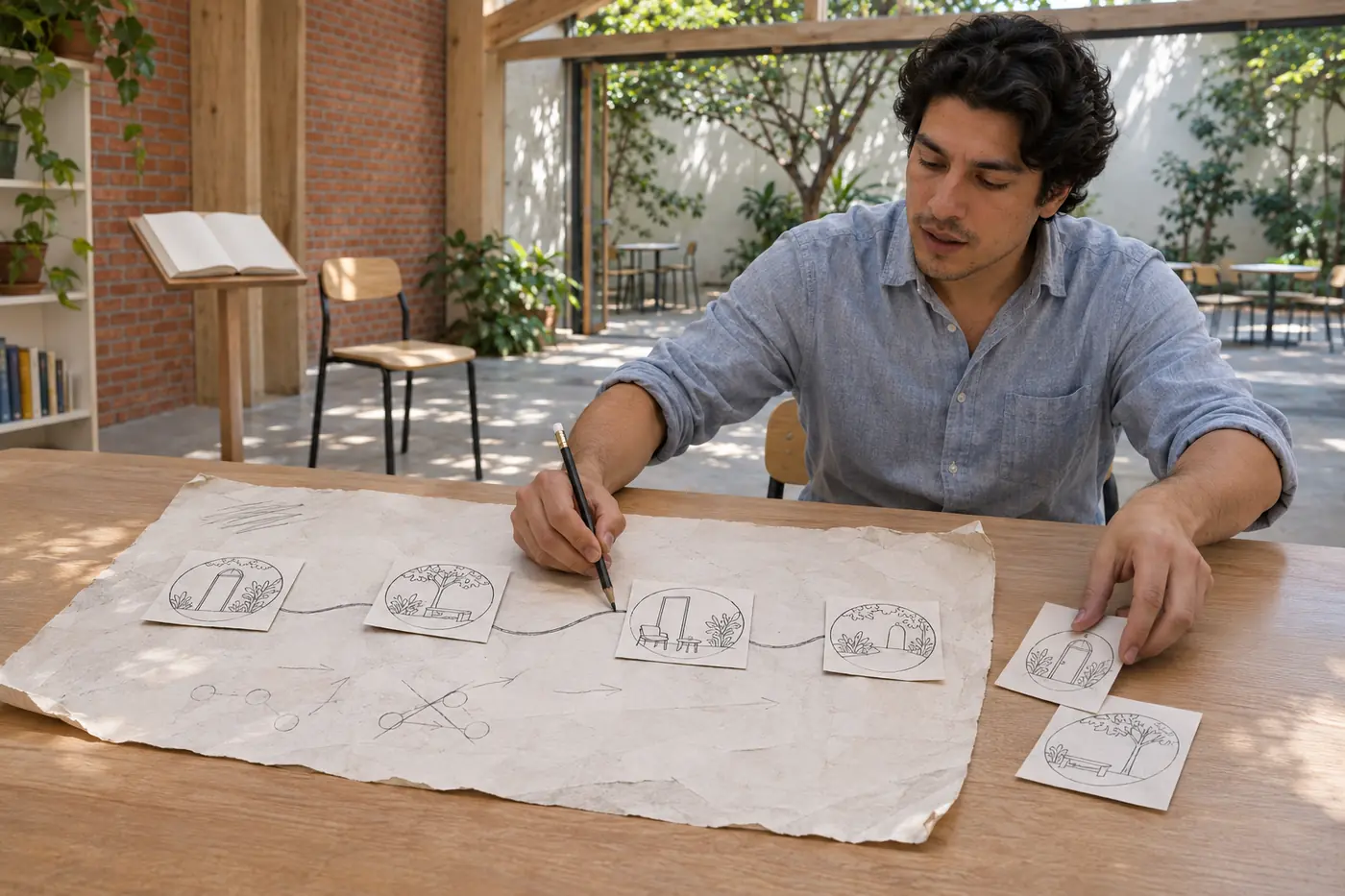
An early estimate treated all visitors as moving and reading at one pace. Oscar revised the interpretation so that a person could use a single seated reading point or a sequence of shorter stops. He labelled the time figures as assumptions and added a question about staff availability rather than assume that extra guidance would always be present.
What the work shows
The final proposal offers a shorter classroom route with a separate explanation of its assumptions and unresolved demands. It does not establish a safe capacity, reduced environmental impact or a confirmed improvement in visitor experience. Those would require evidence beyond the schematic comparison and approvals outside the student’s role.
Next question
Oscar would test the interpretation sequence with an agreed classroom exercise and revise the timing assumptions from that record. He also identifies the separate consultation needed before a real route could operate. The proposal remains useful because it states what was compared and what would have to be checked before implementation.