News
Harbor Archive workshop keeps two accounts in view
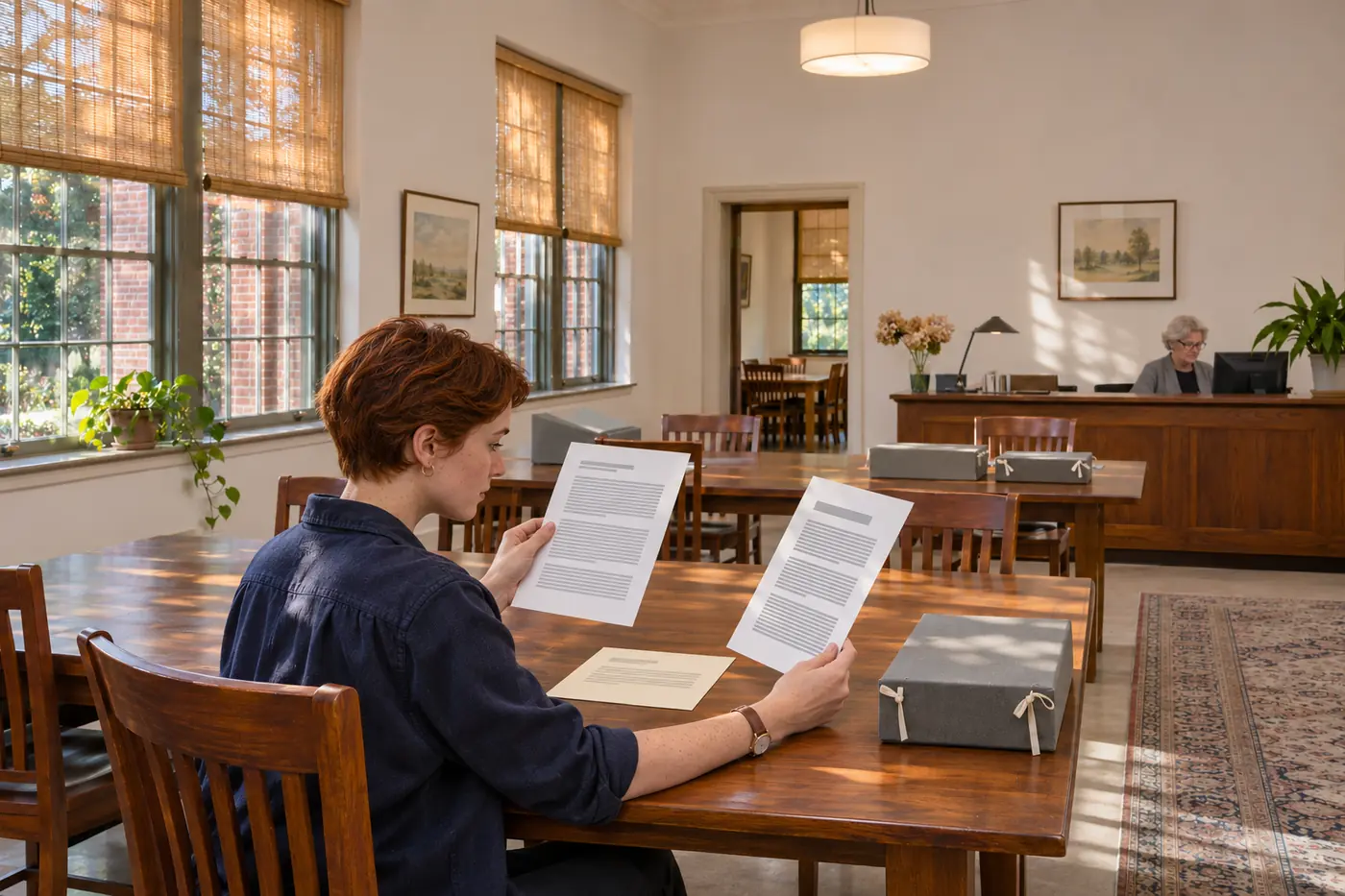
A public-history workshop at Harbor Archive has been editing labels from two original simulated documents about a fictional reading room. The documents disagree in emphasis and come from different moments within the scenario. Instead of asking students to combine them into one seamless story, the exercise asks what each source can support and which question remains unresolved between them.
2026-10-16 / Academic Practice
A public-history workshop at Harbor Archive has been editing labels from two original simulated documents about a fictional reading room. The documents disagree in emphasis and come from different moments within the scenario. Instead of asking students to combine them into one seamless story, the exercise asks what each source can support and which question remains unresolved between them.
Students begin by recording the assigned creator, date, purpose and context of each teaching document. The collection is clearly identified as simulated; no passage is represented as a newly discovered account from a real resident. That label remains attached when a student quotes a sentence, drafts a display or shares a working page with another class.
Program Lead Rafael Ortiz asked groups to distinguish three voices in a short label: the source itself, a student’s paraphrase and the interpretation proposed for the reader. A source note can identify a quotation without making the whole label readable, so the main text still needs enough context to explain why the contrast between the documents matters.
During review, one group removed an imagined recollection that had made its opening more vivid. The sentence sounded plausible but had no basis in the supplied records. The revised introduction instead tells the reader what the two accounts describe and why their different dates affect the comparison. The change made the question more precise while leaving its uncertainty intact.
The workshop also considered what a short public display cannot include. Every selection gives some details more space than others, and a concise label is not a complete history of a place. Students therefore add a small editorial note explaining their choice of sources and the further material they would need before developing the account into a larger interpretation.
The next reading session will compare the labels with their source register rather than judge the text in isolation. Students can arrange research help through the Library and Archives Librarian and a supervised reading appointment at Harbor Archive. The Field Notes case Labels along the Reach presents one complete classroom example, with its simulated documents and editorial decisions identified throughout.
Author and context.
Works on source attribution, alternative historical accounts and practical interpretation for a reader encountering a place.
Rafael Ortiz
Coastal Public History Program Lead
HA 04 · Harbor Archive
Mon/Wed 13:00–15:00 ET
Setting: Harbor Archive. This is an original fictional college news account.